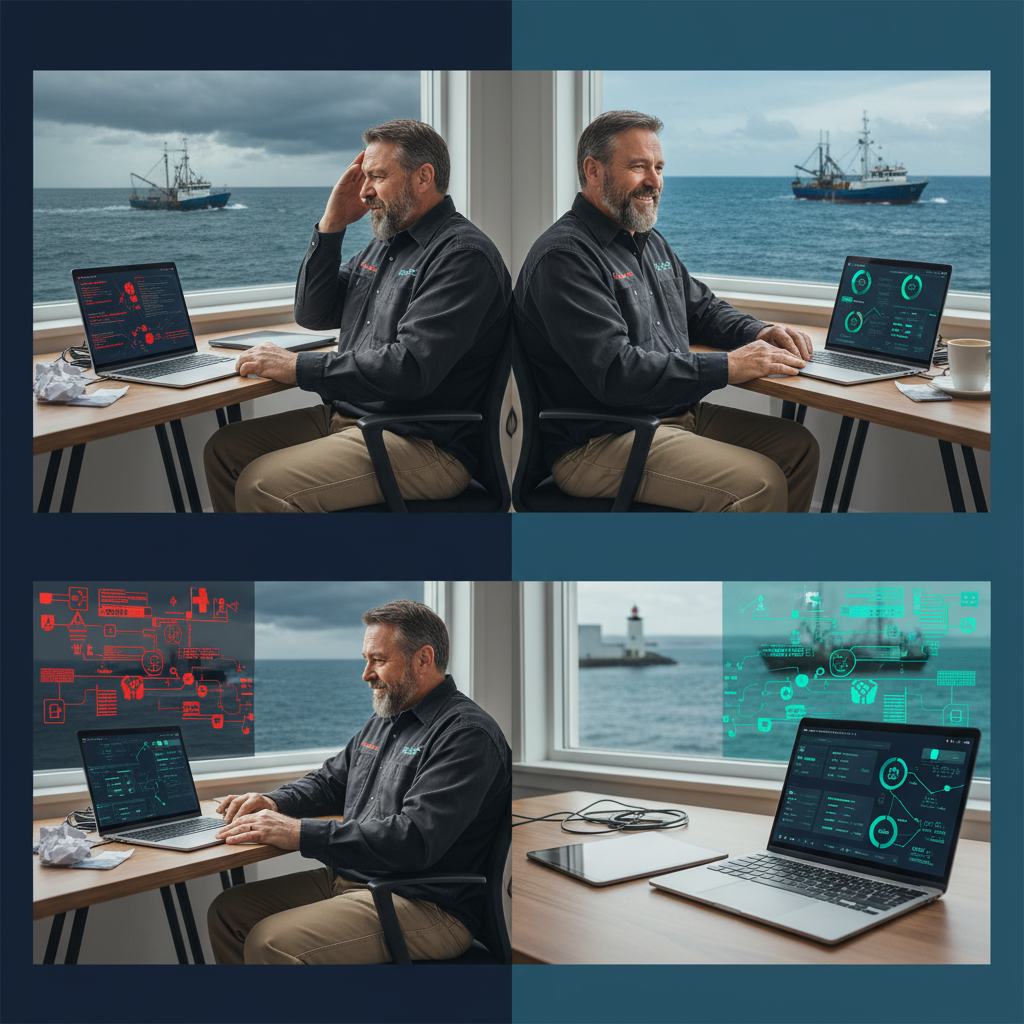
Why 40% of Agentic AI Projects Get Cancelled: A Reality Check for Atlantic Canada Businesses
If you're a trades business owner in the Maritimes thinking about jumping on the AI bandwagon, you need to hear this sobering statistic first. <cite index="1-1,1-2">Over 40% of agentic AI projects will be canceled by the end of 2027, due to escalating costs, unclear business value or inadequate risk controls, according to Gartner, Inc. This can blind organizations to the real cost and complexity of deploying AI agents at scale, stalling projects from moving into production.</cite>
But here's what that research doesn't tell you — the difference between projects that crash and burn versus those that actually transform businesses. As we've helped Atlantic Canadian trades companies navigate this technology over the past year, we've seen both spectacular successes and expensive failures. The pattern is clear: it's not the AI that fails, it's how it gets implemented.
The Hidden Reality Behind AI Project Failures
<cite index="2-1,2-2">Most agentic AI projects right now are early stage experiments or proof of concepts that are mostly driven by hype and are often misapplied. This can blind organizations to the real cost and complexity of deploying AI agents at scale, stalling projects from moving into production.</cite> Sound familiar? It should, because this is exactly what we see happening across Atlantic Canada.
There's another troubling trend called "agent washing" — <cite index="3-10,3-11">the rebranding of existing products, such as AI assistants, robotic process automation (RPA) and chatbots, without substantial agentic capabilities. Gartner estimates only about 130 of the thousands of agentic AI vendors are real.</cite> Translation: a lot of companies are paying premium prices for glorified chatbots.
The numbers get even more stark when you look at broader AI implementation. <cite index="12-4,12-5">For 95% of companies in the dataset, generative AI implementation is falling short. The 95% failure rate for enterprise AI solutions represents the clearest manifestation of the GenAI Divide.</cite> This isn't just about cutting-edge agentic AI — even basic AI implementations are struggling.
Why Projects Derail: The Three Critical Failure Points
Cost Escalation Beyond Control
We see this constantly with trades businesses that start with a "simple" AI phone system and suddenly find themselves quoted $50,000 for setup plus ongoing costs that eat their margins. <cite index="8-1,8-2">42% of AI projects show zero ROI, and an additional 29% say gains have been merely modest. Meanwhile, 88% of AI proof-of-concepts (POCs) fail to transition into production, according to IDC.</cite>
The pattern is predictable: promising demo, enthusiastic sales pitch, then reality hits during implementation. Hidden integration costs, data cleanup requirements, and ongoing management fees that weren't mentioned upfront.
Unclear Business Value Measurement
<cite index="7-13,8-6,8-7">Missing clear metrics and ROI measurement is one reason so many enterprises fall into the 42% AI projects zero ROI category. Too often, success is defined in vague terms like "improved efficiency" without quantifiable proof.</cite>
For a plumbing company in Halifax, "improved efficiency" could mean anything from faster quote generation to better call handling. But if you can't measure whether you're actually capturing more leads or completing jobs faster, you're flying blind. The successful implementations we've deployed focus on concrete metrics: calls answered, appointments booked, quotes generated, and most importantly — revenue tracked from start to finish.
Integration Nightmares
<cite index="1-9,1-10">Integrating agents into legacy systems can be technically complex, often disrupting workflows and requiring costly modifications. In many cases, rethinking workflows with agentic AI from the ground up is the ideal path to successful implementation.</cite>
This is where most Atlantic Canadian trades businesses get burned. They're told the AI will "seamlessly integrate" with their existing CRM, scheduling software, and accounting system. Six months later, they're still trying to get everything talking to each other, and their team is managing three different systems instead of one.
The Atlantic Canada Context: Why Local Matters
Here's something the big tech consulting firms won't tell you: Atlantic Canada has unique advantages that actually make AI implementation easier when done right. <cite index="1-3">According to a January 2025 Gartner poll of 3,412 webinar attendees, 19% said their organization had made significant investments in agentic AI, 42% had made conservative investments.</cite> The Maritimes falls squarely in that conservative investment category — and that's actually good news.
With ACOA's recent $8.5M investment in 40 AI projects for Atlantic Canadian businesses, there's funding available to offset implementation costs. More importantly, our regional business size and scope means we can implement focused solutions rather than trying to boil the ocean.
We've found that HVAC companies with 3-8 technicians, electrical contractors running 2-person crews, and plumbing businesses serving the HRM area hit the sweet spot for AI automation. Large enough to benefit from efficiency gains, small enough to implement without massive organizational disruption.
The Framework That Actually Works
<cite index="2-11,2-12,2-13">To get real value from agentic AI, organizations must focus on enterprise productivity, rather than just individual task augmentation. They can start by using AI agents when decisions are needed, automation for routine workflows and assistants for simple retrieval. It's about driving business value through cost, quality, speed and scale.</cite>
Translated into practical terms for trades businesses:
Start with your biggest pain point. For most Atlantic Canadian trades companies, it's missed calls and follow-up. An AI phone system that actually books appointments while you're on a job site delivers immediate, measurable value.
Layer incrementally. Once call handling is working, add form replies, then quote generation, then social media management. Each layer builds on the previous one instead of trying to revolutionize everything at once.
Measure everything. Track calls answered, appointments booked, quotes sent, and revenue generated. If the system pays for itself within 60 days through captured leads alone, you're on the right track.
Red Flags to Avoid
Based on our experience with both successful implementations and expensive failures across the Maritimes:
- Avoid vendors promising everything. If they claim their AI will handle your phones, manage your social media, optimize your routes, and do your bookkeeping, run.
- Question vague ROI claims. "30% productivity improvement" means nothing without specific metrics tied to your actual business processes.
- Beware of long implementation timelines. If setup takes longer than 30 days, something's wrong. Good AI automation should start working quickly.
- Watch for hidden ongoing costs. per-minute charges, monthly platform fees, and "maintenance" costs that weren't disclosed upfront.
Key Takeaways
- 40% of AI projects get cancelled due to cost overruns, unclear value, and poor integration — but the successful ones transform businesses
- Focus on one specific problem first — typically missed calls and follow-up for trades businesses
- Measure concrete outcomes — calls answered, appointments booked, revenue generated
- Choose vendors with Atlantic Canada experience — local knowledge matters for implementation success
- Start conservative — layer capabilities incrementally rather than attempting comprehensive automation immediately
Ready to Beat the Odds?
The AI revolution is real, but so are the implementation challenges. The businesses that succeed are those that approach it strategically, start with clear value propositions, and work with partners who understand both the technology and the local market.
If you're ready to explore how AI automation could work for your Atlantic Canadian trades business without becoming part of the failure statistics, our Free ROI Audit shows exactly what your missed calls cost you per year — calculated against Maritime trades benchmarks. No pitch, just the math, whether or not you decide to work with us.